The European Parliament Hemicycle
Visit the Hemicycle, the heart of the European Parliament in Brussels, where Members of the European Parliament (MEPs) hold their debates and take crucial votes for Europe.
A visit to the Hemicycle is a great way to soak up the exciting atmosphere of the world’s largest transnational parliament. Come and find out about its powers and role and discover how your MEPS represent you. If you time your visit right, you might also be lucky enough to follow a plenary session from the visitors’ gallery.
* Free
* Free multimedia-guided visits, available in 24 languages
* Interactive talks by experienced speakers: Mondays at 11:00 and 15:00 (in English and in French)
* Book online: see practical information
* A valid proof of identity is required (passport, identity card, etc.).
 The European Parliament Hemicycle
Parlamentarium
Have you ever wondered how the European Union works and how it affects your daily life?
The Parlamentarium has it covered!
Thanks to its interactive tools like a 360° cinema, a role play game for students and a giant interactive floor map, you’ll learn everything there is to know about the European Parliament. Discover the path that led to today’s European Union and what Members of the European Parliament are doing to tackle Europe’s biggest challenges.
* Free
* Available in 24 languages
* Book online : see practical information
 Parlamentarium
House of European History
Get ready for a journey like no other!
The permanent exhibition begins with the myth of the goddess Europa, exploring Europe’s ancient roots and the continent’s heritage of shared traditions, before Europe’s dramatic journey towards modernity in the 19th century and rebuilding process following World War II.
A multimedia guide in 24 languages gives you new ways to interact with the exhibition, while special activities and Family Discovery Spaces allow children to grasp the story of Europe.
Located next to the European Parliament in a striking Art Deco building in Parc Léopold, the House of European History is an essential part of any tour of the city.
* Free
* Available in 24 languages
* Book online: See practical information
 House of European History
Info Hub
Dive into the topics you are interested in with open access research material, policy talks and civil society events, and thought-provoking exhibitions at the heart of the European Quarter. With distinct areas offering access to a variety of content and activities, the Info Hub on the Esplanade Solidarność 1980 caters to many needs. Engage in a dialogue on the European Union and democracy, attend a short policy talk, or simply sit and read more about what is going on in Europe. What is more, with a constantly changing programme of events and exhibitions, you can come back time and time again, and discover something new each time.
Got a question? Ask the friendly staff and they will help you find your way around the Info Hub, or the European Parliament campus.
 Info Hub
Digital Journey to the European Parliament
Are you ready for an online voyage of discovery?
With the Digital Journey to the European Parliament, a free online and immersive experience, you can dive deeper into European democracy from wherever you are. Discover the Parliament in 360°, meet its Members for a day and have your own time-travelled adventure through European History.
Enjoy full immersion to the European Parliament on your computer or in virtual reality with VR-glasses. Stroll through the corridors of the Parliament in Brussels and Strasbourg, tour the office of President Roberta Metsola and even explore the House of European History’s permanent exhibition.
Come and sit in the European Parliament and vote on important EU legislation in this group game. For groups only, 60 to 90 minutes (minimum 16 players).
From whenever you are. Whenever you want. Get started: ep-digital-journey.eu
* Free
* Available in 24 languages
 Digital Journey to the European Parliament
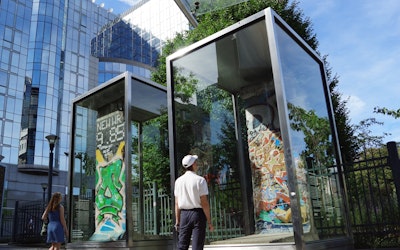
Segments of the Berlin Wall at the European Parliament
Did you know that Brussels is home to several sections of the infamous Berlin Wall. For almost 30 years, this physical and ideological barrier symbolised the intractable division of the European continent into two camps: the liberal and capitalist West and the communist East. In addition to dividing Europe, it also harks back to the Cold War and a global hiatus.
Nowadays, sections of the Wall can be found all over Europe and even beyond. There are pieces in Strasbourg, Tallinn, Reykjavik, New York, Seoul and... Brussels, of course!
You’ll find four original sections of the Berlin Wall in Brussels. Two are showcased near the entrance to the European Parliament, by Léopold Park. They have stood there since 2021, each encased in a glass box, the result of a project to protect them co-organised by the Belgian State, the Brussels-Capital Region and the European Parliament.
While a lot of the graffiti was applied when the Wall divided Berlin in two, artists continued to decorate the Wall after it fell. The piece in the left-hand showcase recalls, not without a slight error, the memory of a momentus international sporting event in 2009: the figures of the new - and still current! - 100m world record, set by Usain Bolt in Berlin. The artist made a mistake: the time was 9.58 and not 9.85!
But how did these pieces of the Wall get there? One of them was donated by the city of Berlin to the European capital in 2004. The second arrived in Brussels in 2009, as part of the celebrations marking the 20th anniversary of the fall of the Wall. On this occasion, ten sections of the former dividing line were installed in Brussels, on Place du Luxembourg. A few months later, all but a few returned to Germany.
This dichotomy between the values defended by Europe - unity, togetherness, the rejection of division - and the situation in Berlin and Germany, which until 1989 was characterised by separation and partition, is quite remarkable!
 Segments of the Berlin Wall at the European Parliament


