House of European History
Get ready for a journey like no other!
The permanent exhibition begins with the myth of the goddess Europa, exploring Europe’s ancient roots and the continent’s heritage of shared traditions, before Europe’s dramatic journey towards modernity in the 19th century and rebuilding process following World War II.
A multimedia guide in 24 languages gives you new ways to interact with the exhibition, while special activities and Family Discovery Spaces allow children to grasp the story of Europe.
Located next to the European Parliament in a striking Art Deco building in Parc Léopold, the House of European History is an essential part of any tour of the city.
* Free
* Available in 24 languages
* Book online: See practical information
 House of European History
Autoworld
An impressive historic building in Brussels, linked with automotive history, is home to Autoworld, the Belgian National Automobile Museum. Situated in the ‘Parc du Cinquantenaire’, the neo-classical building commemorated the 50th anniversary of the Kingdom of Belgium in 1880. From 1902 to 1936 it hosted motor¬car and motorbike exhibitions. Since 1986 it has treasured the major part of Ghislain Mahy’s renowned classic car collection.
Over 300 vehicles, ranging from cars and trucks to motorcycles, are on permanent display. From the earliest models of the dis¬tant past to contemporary cars that prefigure the automobile of tomorrow, visitors are guided through the motorcar’s history dating as far back as 1896.
Various cars representing the most exciting years of the auto¬mobile history since 1960 can be approached and admired from close by, thanks to a brilliantly designed scenography.
Special sections focus on sports and competition, cars owned by the Belgian Royal Family, micro and bubble cars, and car design. The Belgium at Autoworld section is dedicated to the roots and history of the Belgian car industry.
Autoworld is a museum on the move, with temporary exhibi¬tions taking on various automotive themes organised through¬out the year.
More detailed information on autoworld.be
 Autoworld
Institute of Natural Sciences
The Institute of Natural Sciences: a great day out, naturally!
In the largest Dinosaur Gallery in Europe, you can meet the famous Bernissart Iguanodons, T.rex, Triceratops, Diplodocus, and 34 other species.
But that’s not all!
The Earth is swarming with life - rediscover it in the Gallery Living Planet, through an aesthetic, family-friendly and scientific approach to biodiversity. Learn about the human body and how we evolved in the Gallery of Humankind and go back in time in the Gallery of Evolution. You can also find out about urban species in BiodiverCITY, discover 250 years of the history of Natural Sciences through 14 iconic specimens, beware of the kings of the Cretaceous seas in the Mosasaur Hall or admire the magnificent crystals in the Mineral Hall.
And last but not least, don't miss the temporary exhibitions and all the activities of the Educational Service: more information at www.naturalsciences.be.
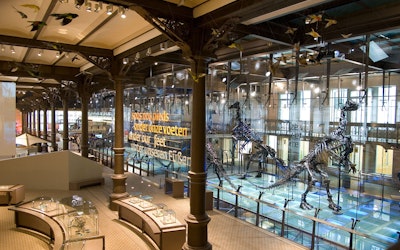 Institute of Natural Sciences
Art & History Museum (RMAH)
Embark on a fascinating journey through art and history! Come and stroll among the prehistoric flints and Egyptian mummies, walk between the ancient glasses and stand back to contemplate the impressive medieval tapestries. Immerse yourself in the oriental world as you pass Asian Buddhas and travel to the other side of the world to see a gigantic statue from Easter Island. You still have to admire the magnificent collection of Belgian Art Nouveau...
The Art & History Museum is part of the Royal Museums of Art and History (RMAH) that also cover the Musical Instruments Museum (MIM), Halle Gate and the Museums of the Far East (currently closed for renovation).
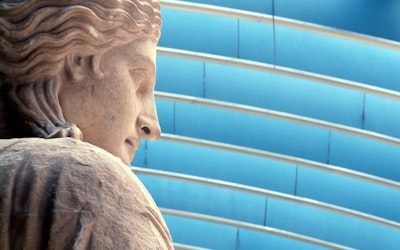 Art & History Museum (RMAH)
War Heritage Institute (Royal Military Museum)
Here you’ll find medieval armour and souvenirs from the Napoleonic campaigns, as well as a hundred or so aircraft and armoured vehicles from the two Great Wars. A breathtaking panoramic view awaits you at the top of the Arcade.
Since May 1, 2017 the Royal Military Museum is part of the War Heritage Institute, the new reference institution for military heritage and remembrance in Belgium.
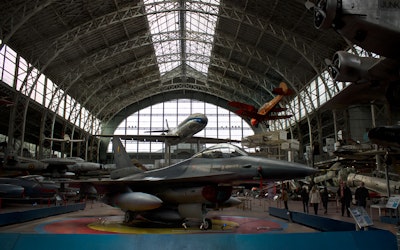 War Heritage Institute (Royal Military Museum)
European Parliament
Discover the beating heart of European democracy, responsible for over 500 million citizens across the European Union. The European Parliament in Brussels offers a unique experience for visitors of all ages and backgrounds. All activities are free of charge and available in the 24 EU languages.
 European Parliament
Parlamentarium
Have you ever wondered how the European Union works and how it affects your daily life?
The Parlamentarium has it covered!
Thanks to its interactive tools like a 360° cinema, a role play game for students and a giant interactive floor map, you’ll learn everything there is to know about the European Parliament. Discover the path that led to today’s European Union and what Members of the European Parliament are doing to tackle Europe’s biggest challenges.
* Free
* Available in 24 languages
* Book online : see practical information
 Parlamentarium
Experience Europe
Experience Europe is a new, free, permanent exhibition in the heart of Brussels' European Quarter. Accessible every day, it immerses visitors, virtually, in a fun and interactive environment, where they can learn about the work, priorities and core policies of the European Commission and the values of the European Union.
It gives you the opportunity to meet virtually the President of the European Commission; to live an immersive experience where the EU is in action, to discover the emblematic Berlaymont building; or to improve your knowledge of the EU through fun games.
All of the exhibition content is available in the following 7 languages (NL, FR, DE, EN, ES, IT, PL). A large part of the exhibition is also available in all 24 of the European Union languages (including the interactive games).
If you are interested in this European immersion, don't hesitate to visit the Experience Europe website to get more information.
 Experience Europe
Cauchie House
"Our spaces are currently not available for rental. Please visit this page again for future update."
The Cauchie House is one of the most exceptional Art Nouveau masterpieces in Brussels. Built in 1905, it was originally the home to Paul Cauchie and Caroline Voet, a couple of artists and decorators. The majestic sgraffito on the façade and the opulent decorations of the bel-étage served as a manifesto for their artistic skills. We invite you to join us for a guided tour to discover its history and unique artworks.
Open every Saturday of the month. Individual guided tours, group guided tours.
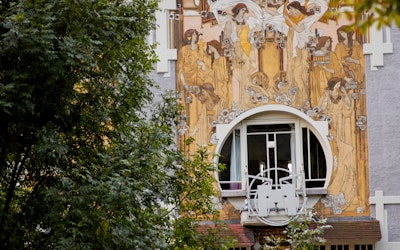 Cauchie House
Saint-Cyr House
The most extravagant and astonishing example of Brussels Art Nouveau is undoubtedly Saint Cyr House, with its magnificent ironwork as its most striking feature. Masterfully decorated with abundant and lush use of glass and iron on the very narrow four-metre wide façade, the house is an unmistakable eye-catcher.
It was built between 1900 and 1903 as the home of painter and decorator Léonard de Saint-Cyr and was designed by Brussels architect Gustave Strauwen, a pupil of Victor Horta, at the age of just 21.
In 1967, the chief architect of the City of Brussels said of the facade: "It lacks the unity so necessary for any work of art; the different elements clash and give an impression of disorganised and inharmonious fantasy, further accentuated by the presence of an external staircase of dubious taste". Six years later, opinions still had not changed: "it is a tumultuous work, of disconcerting proportions, which reminds one more of a theatre set than of a serious, ordered and logical architectural ensemble", concluded the Commission Royale des Monuments et Sites (Royal Commission for Monuments and Sites).
 Saint-Cyr House
The Berlaymont building
The cross-shaped Berlaymont building, headquarters of the European Commission with a typical 60s look, was built in 1967. The first things to catch the eye are the four asymmetrical main wings and the enormous public esplanade that passes under them thanks to an ingenious support structure. This impressive feat of engineering allows for only the centre of the structure to be in contact with the ground, giving the illusion that all four of the wings appear to be floating above the ground.
The adjacent Schuman roundabout not only provides a wonderful view of this key symbol of European decision-making in Brussels, but also on the brand-new Europa building, headquarters of the European Council and the Council of the European Union.
The Berlaymont underwent comprehensive renovations that began in 1995 and were completed in 2004.
The building owes its name to the Dames du Berlaymont (Sisters of the Berlaymont) convent. The Dames du Berlaymont order was created in 1625 by Countess Marguerite de Lalaing, wife of Count Florent de Berlaymont. The Belgian state bought the land in 1962, when the order moved to Argenteuil.
 The Berlaymont building
Council: Europa building
The Europa building of the Council of the EU
The Europa building is one of the most recent and magnificent examples of contemporary architecture in Brussels. The enormous cube is made up of 3 750 restored window frames and contains a glass lantern that, at night, is beautifully lit up by 374 LED tubes. This ‘House of the European Member States’, with its multicoloured interior, is the main seat of the European Council and of the Council of the EU, and is where meetings between EU ministers and heads of government are now held.
Philippe Samyn, the Europa building’s lead architect, sees it as the expression of a number of the values espoused by the EU. The façade thus consists of window frames from every EU country which signify both the diversity (‘United in diversity’) and the craftsmanship of every Member State, as well as the desire to promote sustainability. Thanks to the collection of rainwater, the use of solar panels across the whole area on the top of the building, and the optimised façade structure, the Europa building has been awarded the Valideo environmental certificate. The interior lantern, built in a shape that was necessary to avoid too much pressure being exerted on the ground and the underground metro tunnels, mainly contains meeting rooms and a large press room and press area.
The Belgian artist Georges Meurant has created a vibrant polychrome interior with an array of different coloured squares on the walls, doors, lifts and carpeting. The squares feature all the colours that appear on the flags of the 28 Member States.
In addition, the splendid Art Deco Résidence Palace, designed by the architect Michel Polak and constructed between 1922 and 1927, was incorporated into the project.
The Council is open to the public and offers individual or group visits. All visitor activities are free of charge. You can explore our Visitors’ Centre to learn about the Council's work and about the EU as a whole. Moreover, you can visit the Council buildings or meet our experts at information sessions. It is also possible to take part in a guided tour, which gives visitors the opportunity to take a peek behind the scenes at the Council.
Visits must be booked in advance. Information about the different types of visit and how to make a reservation can be found on the following pages: https://www.consilium.europa.eu/fr/contact/visits/
Visitors’ Centre opening times: Monday to Friday: 10:30 – 16:00 (10:30 – 13:00 in August). The Visitors’ Centre is closed on certain Belgian public holidays and on official holidays of the EU institutions.
 Council: Europa building
Leopold Park
Leopold Park is a slice of nature in the heart of Brussels’ European Quarter. Formerly a zoological, horticultural and leisure garden in the 19th century, it became a science park, and is now an English-style garden. Wander it’s paths and admire sculptures such as the Bust of Jean-Jules Linden, or the Tree of Peace.
Numerous Belgian and European institutions are located in and around this park: Solvay Library, the Louis Pasteur Institute, the Anatomy Institute, the Physiology Institute and the former Business School… Take the opportunity to step into the European Parliament Hemicycle and visit the Parlamentarium, the House of European History, the Museum of Natural Sciences and the Wiertz Museum.
Go for a stroll in Cinquantenaire Park, another imposing space in the capital.
 Leopold Park
The Ambiorix, Marie-Louise and Marguerite squares
The Ambiorix, Marie-Louise and Marguerite squares are located in the former valley of the Maelbeek river, near the European Quarter. They are located in the so-called "squares" district, which is architecturally rich thanks to its neo-renaissance, neo-gothic and Art Nouveau houses, which intermingle with the eclecticism. Water is the primary element of this cascade of parks and is integrated into each of them, reconstituting the old course of the Maelbeek.
Square Ambiorix is laid out in French terraces with geometric spaces, straight paths, flowerbeds, fountains, sculptures…
Square Marie-Louise is dominated by a pond, which is home to Florida tortoises. Its rock garden containing a fountain, a false grotto overgrown with vegetation and waterfalls and its English gardens give it a picturesque and romantic feel.
As for Square Marguerite, this "agora space" has a playground and a pergola and welcomes young people and athletes looking to let off steam.
Along the squares, admire the Hotel van Eetvelde and Saint-Cyr House, true masterpieces of Art Nouveau. Take a walk in Brussels Park, Leopold Park or Cinquantenaire Park and visit their museums and the Charlier Museum in nearby Saint-Josse-ten-Noode.
 The Ambiorix, Marie-Louise and Marguerite squares


%20T%20Hubin%20-%20RBINS.jpg/_jcr_content/renditions/cq5dam.thumbnail.48.48.png)


