Théâtre National Wallonie-Bruxelles
The Théâtre National Wallonie-Bruxelles is, in French-speaking Belgium and far beyond, a leading force in the democratization of culture. Since its creation in 1945, its foundations and guiding principles have been rooted in collective engagement, artistic excellence, ethical responsibility, critical thinking, and cultural decentralization.
At a time when the global trend is increasingly towards inward-looking attitudes, the Théâtre National chooses to foster circulation and exchange. In particular, it explores new forms of collaboration with artists and other cultural organizations, as well as new ways of engaging with audiences. In an era marked by profound transformations, whether social, environmental, or digital, it does not hesitate to question sector practices, embracing a dynamic of sustainability, care, dialogue, and co-creation.
 Théâtre National Wallonie-Bruxelles
Belgian Museum of Freemasonry
Historic and thematic overview of the history of freemasonry in Belgium.
The Belgian Museum of Freemasonry is a gesture of openness, an invitation by an institution renowned for it’s discretion and veiled in mystery, to get acquainted with its history. The museum, situated in an exquisitely restored neoclassical townhouse (house Dewez, late 18th century), presents artworks, ritual objects, jewellery, textiles, documents and books from the 18th century and on. They illustrate the origins, historic evolution, workings, ideas and present structures of freemasonry.
Exceptional opening:
First Sunday of the month: 13.00 - 17.00 free admission
 Belgian Museum of Freemasonry
MAD Brussels
MAD Brussels is a Brussels’ platform for gathering expertise from the city’s Fashion and Design sectors. It aims to help with the promotion and development of Brussels stylists and designers and improve their exposure nationally and abroad.
The opening in April 2017 of their brand new, sparkling white headquarters marked something of a renaissance for the non-profit organisation, which can now multiply and combine its campaigns. It houses a ressource centre for professionals of the creative industries and related sectors, along with adaptable workspaces, meeting spaces, workshops, seminar rooms and a large space dedicated to public activities where multiple events are organised every year: exhibitions, fashion shows, artistic performances…
 MAD Brussels
Greta Meert
Occupying an impressive Art Nouveau building designed by the architect Louis Bral and then restored by architects Hilde Daem and Robbrecht, the gallery was founded in 1988 under the name of Gallery Meert Rihoux. In 2006, it changed direction and assumed the name of the new director, Greta Meert. From the start, the gallery has placed the emphasis on the minimal and conceptual art of the seventies (Donald Judd, Robert Mangold, Richard Tuttle, Robert Barry, Hanne Darboven, Niele Toroni) and also paid particular attention to photography from the eighties (Thomas Struth, Louise Lawler, Jeff Wall, Ken Lum, Ian Wallace and John Baldessari. In addition, the gallery presents a more future-focused selection of artists including Eric Baudelaire, Iñaki Bonillas, Johannes Esper, Valerie Krause, Anne Neukamp, Tobias Putrih and Johannes Wald and the Belgian artists Edith Dekyndt, Stef Driesen, Sophie Nys, Koen van den Broek, Catharina van Eetvelde and Pieter Vermeersch.
 Greta Meert
Théâtre des Martyrs
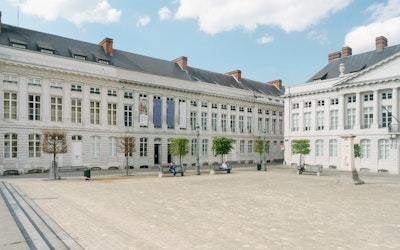 Théâtre des Martyrs
Le Jardin de ma Soeur
The desire to present theater amongst people; as if a performance is nothing but a conversation, in a place somewhere in between the large halls and the streets, half living room, half pub, in a warm ambiance where one can sip a glass while watching a performance. That's cafe-theater "Le Jardin de ma Soeur", at the edge of the ancient "Grand Béguinage de Bruxelles", alongside one of the quays of the old port of Brussels where the spirit of the dock workers lingers and where one can still feel the presence of the beguines with their long black robes.
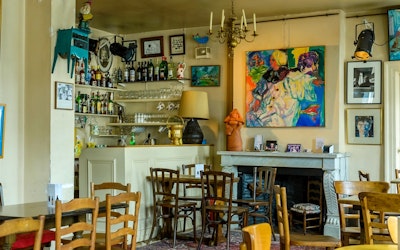 Le Jardin de ma Soeur
BRONKS
BRONKS is Brussels’ Dutch-language theatre for young audiences with own productions and a varied and well-considered choice of guest productions in which both beginners and established artists are asked to deal with relevant and provocative topics in a way that appeals to a young audience. BRONKS productions are appealing and relaxing, but also contrary and demanding. It is theatre that reflects on the world and provides means by which to understand it better. BRONKS has also an extensive educational operation and organises festivals and events to suit a variety of audience groups.
Theatres & concert halls
 BRONKS
KVS - Koninklijke Vlaamse Schouwburg
KVS has hi-tech infrastructure at the beautifully restaured site on Lakensestraat/Rue de Laeken (the renovated auditorium called KVS_BOL, and the Top), and in the new building at Arduinkaai/Quai aux Pierres de Taille (the 'black box' ). KVS's programme is as diverse, colourful and exciting as Brussels itself with a variety of new KVS productions, revivals of past successes, local and international guest performances, theatre, dance, music, film, literature, stand-up comedy, debates, parties, etc.
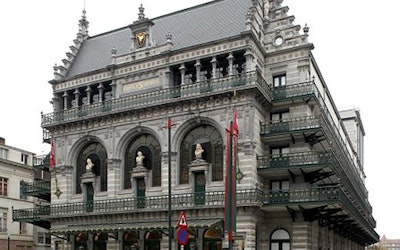 KVS - Koninklijke Vlaamse Schouwburg
Cinéma Palace
A new spot for art house films, local food and events in the center of Brussels.
A CINEMA FOR EVERYONE
Palace is intended to cater for everyone, from film buffs to professionals, along with visitors whose occasional trips to the cinema form part of a full programme comprising a dinner and a movie, followed by a drink to round off the evening.
Palace will open its doors to all the communities who breathe life into the centre of the city : the multicultural populations in the southern district, the schoolchildren in the Lower Town and the associative actors who see the cinema as a permanent force for education. And, as its entire infrastructure has been designed to welcome everyone without exception, Palace also invites visitors with limited mobility to experience the magic of the “Seventh Art”, ensuring that they have
unrestricted access.
 Cinéma Palace
Halles Saint-Géry
Halles Saint-Géry is a cultural centre located in the heart of Brussels, in a remarkable heritage-listed building.
Since June 2026 Marché Saint-Géry brings new life to the historic Halles Saint-Géry, a landmark of Brussels heritage, built in 1881. Fifty years after the closure of the original market, this iconic venue is being returned to its original purpose of providing visitors with a welcoming, lively and inviting marketplace that preserves its cultural role in the heart of Brussels.
With exhibitions, meetings, performances, concerts and other major events, it reaffirms its role as an ambassador for heritage, determined to preserve, transmit and reinvent Brussels' legacy.
A unique space combining exhibition, dining and relaxation facilities, Les Halles Saint-Géry is a celebration of Brussels savoir-vivre, where history can be savoured as much as contemplated, in a spirit of conviviality and celebration.
This project is under the aegis of the Brussels-Capital Region.
 Halles Saint-Géry
Dépendance
The Dépendance gallery was founded in 2003 in Brussels by Michael Callies and Stephan Jaax. Since its inception, it has represented and exhibited artists whose work is as specific, individual and diverse as the artists themselves. Discover it in the heart of Brussels!
 Dépendance
Beursschouwburg
Apart from a pile of attractively stacked bricks in the heart of Brussels, the Beursschouwburg is, for the time being, principally an inspiring platform for between-the-arts. Here, artists reflect, show, scrap and start again in an ongoing dialogue with thinking and creative Brusseleers. The Beursschouwburg is a melting-pot and a thorn in the side, where art is served while it’s still hot. Where, now and again, artists rattle the programming. Where there’s more to life than art. Where performance, celebration, encounter and craziness all join in a merry dance.
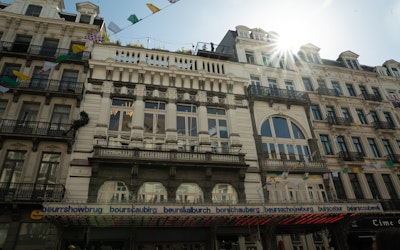 Beursschouwburg
Les Riches-Claires
 Les Riches-Claires
AMVB - Archives and Museum of Flemish Life in Brussels
The museum throws light on Flemish culture in Brussels with the help of documents, photographs, archives, posters, flags, and sculpture from the 19th century to the present day. All the great figures of Flemish Brussels history are here: Julius Hoste, Charles Buls, members of the “Van-nu-en-straks” movement, and others. The archives contain priceless material, directly related to events in the cultural emancipation of Flanders in the capital, such as the establishment of the Flemish Theatre.
 AMVB - Archives and Museum of Flemish Life in Brussels
10/12
 10/12
10/12
