Architecture walk: from medieval to eclectic
30 July 2026

A melting pot of styles in the city centre
For lovers of old buildings and history, this walk crosses the centre of Brussels, taking in everything from its first wall and the boulevards built at the end of the 19th century - inspired by the Haussmann boulevards in Paris - to the sumptuous royal district.
Are you ready for a fascinating journey through time? This itinerary is divided into stages. You can enjoy it at your own pace and according to your preferences. Let's go!

Stage 1
The birth of Brussels
Medieval
Head to Anneessens Tower on Boulevard de l'Empereur, between numbers 34 and 36. This is one of the incredibly well-preserved remains of Brussels’ first city wall. These ramparts, built at the beginning of the 13th century, extended over 4km, with seven gates and an incredible 50 towers. For another relic of the original wall which protected Brussels, head to Rue de Villers where a curtain wall and another sandstone tower, the Villers tower, have been preserved.
Then make your way to the Bourse, where you’ll find Bruxella 1238, the archaeological remains of the Franciscan convent established in Brussels in 1238. The site is home to the tomb of John I, Duke of Brabant, who died in 1294.
(For a little glimpse of the past, admire the magnificent Bourse, an eclectic building influenced by the neo-Renaissance, inaugurated in 1873 and designed by architects Léon-Pierre Suys and Jules Brunfaut and which houses Belgian Beer World, the beer museum.)

Behind the Bourse, you’ll find Saint-Nicholas’ church, one of the city’s first four churches. The original Romanesque building dating back to the 12th century has disappeared, but the chancel, from 1381, still stands. The facade was rebuilt in 1956 following extensive damage.
Other sites that might interest you: The Black Tower, which is located behind Saint Catherine church and was part of Brussels’ first city wall; and the remains of Coudenberg Palace on Place des Palais (a square you will also discover later if you follow this itinerary). The palace, which dates back to the 11th century, was destroyed by a fire in 1731. However, you can see the remains of the kitchens, the cellars of the main building and the foundations of the famous Aula Magna ceremonial hall, where Charles V (1500-1558) abdicated in 1555.
Stage 2
The magic of the Grand-Place (and beyond)
From Gothic to Neoclassicism
Head to the Grand-Place and prepare to be amazed by the most beautiful square in the world (according to Victor Hugo, who stayed there). It has been a UNESCO World Heritage Site since 1998 and owes its current appearance to the shelling that destroyed it in 1695. Only the Town Hall was spared because its tower, which dominates the city, as it served as a landmark for the enemy artillerymen. The first part of this building was built in the Gothic style during the first half of the 15th century. The square was rebuilt in just a few years after its destruction, taking its influences from the in-vogue baroque style of the 17th century, hence the impression of unity that emanates from the site. However, the appearance of the square has further evolved over time and through several restorations. The King's House, for example, which stands opposite the City Hall, was rebuilt in 1873 in a neo-Gothic style to recall its late Gothic appearance during its reconstruction under Charles V. The building now houses the Brussels City Museum.
Stop for a drink in one of the establishments on the Grand-Place which preserve a "period" atmosphere. Guided tours are available for visitors to discover the rich interior of the City Hall.
Two churches around the Grand-Place embody the baroque movement that swept through Brussels: Notre-Dame de Bon Secours, on rue du Marché au Charbon, built between 1664 and 1694 and restored after the shelling of the city in 1695. Close by, Notre-Dame aux Riches Claires, built between 1665 and 1680. When it became too small, two side naves were added; one on the left, built in 1824, and one on the right in 1833.
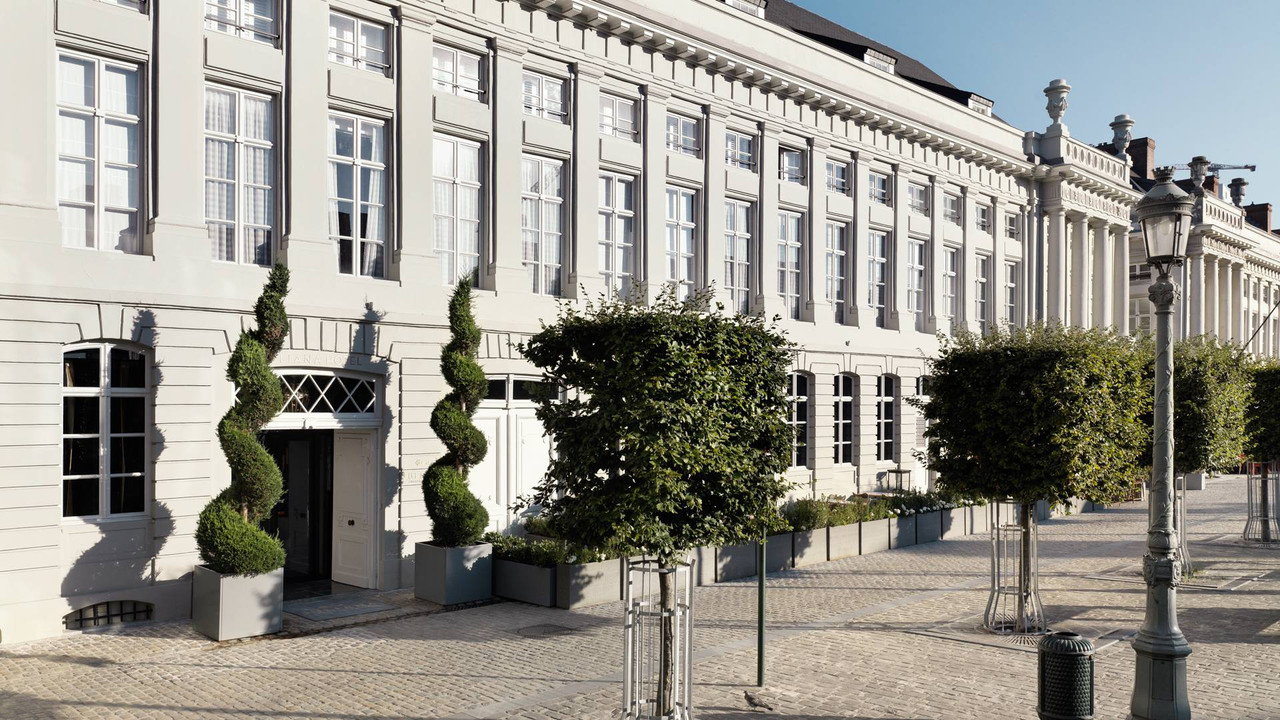
Before heading to the upper city, take a small detour to marvel at the neoclassicism of the Place des Martyrs. The first major urban and architectural project carried out in Brussels, composed of bourgeois houses and private mansions, the square revealed a new homogeneity at the time of its construction (1774-1776) and followed the neoclassical trend of the great French constructions of the 18th century.
On the way to the Royal Quarter, you’ll come across the Cathedral of Saints Michael and Gudula, a gothic heritage building which was constructed progressively from the 13th to the 15th century. Specialists see it as a perfect illustration of the transition from the primary to the late Gothic style.

Jordan Jelev
Stage 3
The Royal Quarter
Neoclassicism
Make your way to Place Royale.
A couple of small anachronisms on the way: n° 31 Rue Ravenstein, the resolutely modern head office of BNP Paribas Fortis, completed in 2021, and its white concrete columns encircling the building; next door, Bozar (Brussels’ Centre for Fine Arts), an Art Deco building designed by Victor Horta and opened in 1929.
A step back in time: next to Bozar, at 3 Rue Ravenstein, admire the old Cleve-Ravenstein Hotel in the late Gothic style, built at the turn of the 15th and 16th centuries. Follow the road up to the Place Royale. The street becomes the Coudenberg.
Other notable buildings: at number 68, admire the old English Pharmacy of Charles Delacre (yes, the founder of Delacre biscuits). Don't be fooled by its ancient appearance, the store was built in 1898 in the neo-gothic style by architect Paul Saintenoy. The same year, work began on a jewel of Art Nouveau in Brussels, the Old England store, designed by the same Paul Saintenoy and which today houses the Musical Instruments Museum (again, don't panic, see day 2 for Art Nouveau). Admire the view over the lower part of the city from the top of the Mont des Arts.
Back to the 18th century! At the end of Coudenberg, you reach the Place Royale (under which lie the archaeological remains of the Coudenberg Palace, which are well worth a visit). This neoclassical, rectangular and symmetrical square is home to such wonders as the church of Saint James on the Coudenberg and the statue of Godfrey of Bouillon; the BIP and, on the other side, the Magritte Museum, which is connected to the Royal Museums of Fine Arts.

© visit.brussels
Head to Place des Palais, where you’ll find the majestic Royal Palace. This neoclassical monument, the result of the combination of several buildings, belongs to the Belgian State, which makes it available to the king for his work. Opposite the palace, Brussels Park (formerly the Royal Park) is a "French-style" garden in the neoclassical trend, with a forest and a geometric design laid out in the 18th century and dotted with statues dating from the early 19th century. On the other side of the park lies the Palace of the Nation, the country's parliament, still in the neoclassical style, just like the buildings that surround the park.
Have you gone for a little stroll? Then make your way back to Place Royale and it's time to move on towards Place des Musées to discover the palace of Charles of Lorraine, the Royal Protestant Chapel and the Palace of National Industry, an impressive neoclassical ensemble built during the second half of the 18th century (with changes made during the 19th century).
Stage 4
Rue de la Régence, the Palace of Justice and the Marolles
Neoclassicism, neo-baroque & eclecticism
Head down Rue de la Régence towards the Palace of Justice and discover an eclectic mix of neo-baroque and neoclassical architecture along the way. No sooner have you left the square than you can admire, on your left, the former palace of the Count of Flanders, now the Court of Auditors, in this superb eclectic and neo-baroque building. Just a few short steps away, on the other side of the street, is the grandiose entrance to the Royal Museums of Fine Arts of Belgium, a building built in an eclectic style, with a preference for classical aesthetics.
Just before reaching the Sablon, you’ll come across another imposing building: a piece of brutalism in this world of neoclassicism with the former extension of the Cour des Comptes, now home to the Korean Cultural Center.
It’s impossible to miss the nearby Our Lady of the Sablon church, which separates the Grand Sablon (on your right, behind the church) from the Petit Sablon on your left. This gothic monument, built in the 15th and 16th centuries, was restored and modified, mainly in a neo-gothic style, at the end of the 19th century.
If you feel like taking a break, you can enjoy the greenery of the Petit Sablon or sit in one of the cafés and bars of the Grand Sablon.
Back on Rue de la Régence, head towards the Palace of Justice. Right around the corner, at number 9, is an old, private mansion in an eclectic neo-Louis XVI style, renovated at the end of the 1980s in a postmodernist style (another anachronism!). You’ll find more eclecticism and neoclassicism at 11, 13, 15, 21, 23-25, 26, 27 (with a touch of neo-Renaissance), 29 (the institution of the Sisters of Our Lady with its touch of neo-baroque) and at 33, 34 to 48 and 67.
On the other side of the street, don't miss the French neo-Renaissance style Royal Conservatory of Music and, further along, at n° 32, Brussels’ Synagogue, built between 1875 and 1878 in a Romanesque-Byzantine style.
You now find yourself in front of Brussels’ imposing Palace of Justice, on Place Poelaert, named after the architect who designed the building in 1862. Its construction lasted from 1866 to 1883, in an eclectic style of Greco-Roman inspiration. It remains one of the most remarkable monuments of 19th century Europe.
Next, we move on to the Marolles district. Take the lift to the right of the Palace of Justice to reach the lower part of the city. Walk down the square to Rue Haute, an architectural mix that spans the 16th to 19th centuries. Bruegel house stands at n° 132. Built in the 16th century in a Flemish Renaissance style, it once belonged to the family of the famous painter Pieter Bruegel the Elder.
Stage 5
Haussmannian inspiration in Brussels
Eclecticism
If you’re still feeling brave enough, go back down towards the centre and join Boulevard Adolphe Max, built between 1867 and 1871 and copied from the Haussmann model. Here again, you’ll find many eclectic and neoclassical buildings. Start at the end of the street, at number 164, with the Cécile Hôtel/Le Dôme. The building, designed by Alban Chambon in 1906, has elements in both the eclectic and Art Nouveau styles. Step into the street and admire the buildings as you pass them. Enter the Passage du Nord, an eclectic covered gallery designed by Henri Rieck and built between 1881 and 1882.
At the end of the boulevard is Place de Brouckère, where, at number 41, you can admire the Continental Hotel (with its illuminated sign on the roof) dating from 1874 and designed by Eugène Carpentier in an eclectic style. Also on the square is the magnificent Métropole Hotel dating from 1895, designed by Antoine Trappeniers, which has sadly been closed since 2020. The building combines eclectic, neo-Renaissance and neo-rococo (neo-Louis XV) styles.

© visit.brussels - Jean-Michel Byl

If you fancy it, continue to Place du Béguinage, a neoclassical architectural ensemble that surrounds the baroque church of Saint John the Baptist at the Béguinage. In need of a break? Cross Rue de l’Infirmerie towards the Grand Hospice, the temporary home of the Pacheco hospice, where you can have a drink and a bite to eat. The neoclassical building was built between 1824 and 1827 based on plans by architect Henri Partoes.
We hope you enjoyed this walk through a part of Brussels' history.


And hotels