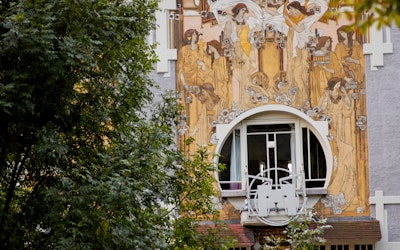
Musée Magritte Museum
The Musée Magritte Museum, located in the heart of Brussels, brings together the world's largest collection of the renowned surrealist artist René Magritte: 230 works and archives are displayed. The multidisciplinary space houses paintings, gouaches, drawings, sculptures, and painted objects, as well as advertising posters, musical scores, photographs and films. The Museum also has the most important collection from the artist’s "vache" period.
The selection of works exhibited in the Royal Museums of Fine Arts of Belgium is constantly expanding with a changing selection of external loans. With the support of Belgian and foreign museums as well as private collectors, works are being made available that have previously never been exhibited. The visitor can thus discover many treasures that are still in private possession.
The Musée Magritte Museum has already received 8 nominations and prizes. Every year more than 300,000 visitors come here for all over the world to discover the life and the works of René Magritte.
 Musée Magritte Museum
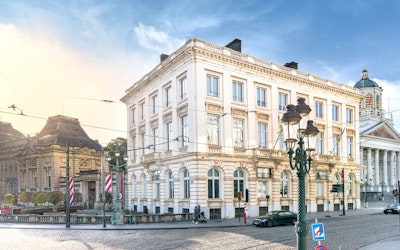
BELvue museum
Chips, beer and chocolates... surely there is more to Belgium than that? Democracy, prosperity, solidarity, pluralism, migration, languages and Europe: these are the themes used by the BELvue Museum to help you to discover Belgium. Each one is developed through present-day testimonials and then traced right through history. This is a modern, original way of gaining a fuller understanding of modern-day Belgium.
Have a look at the gallery too: there are more than 200 objects to view, each one forming a tangible memory of Belgium. Here are just a few examples: a lithograph by Magritte, a motorcycle, crystal vases by Val Saint-Lambert, and a football signed by the Red Devils. The very essence of Belgian-ness!
Speciale openingstijden op schoolvakanties en feestdagen 9.30 tot 17.00 uur
24/12 en 31/12 9u30 tot 16u00
Het BELvue Museum is elke woensdag vanaf 14u en de eerste zondag van de maand gratis toegankelijk.
 BELvue museum
Coudenberg Palace
Once upon a time, the Coudenberg Palace towered over the city of Brussels. Charles V and many other of the most powerful rulers ever to reign in Europe made this princely residence their home between the 12th and 18th centuries, until it was consumed by a terrible fire. Every trace of this prestigious palace simply disappeared underground for many years. Today, however, these ruins constitute a fascinating archeological site incorporating a network of underground passages and chambers.
When you visit it you can explore the principal buildings of the palace and enjoy a stroll along the Rue Isabelle, which is now underground. In the Coudenberg Museum, located in Hoogstraeten House, the finest of the archeological discoveries made during the various excavations of the Coudenberg site are displayed.
 Coudenberg Palace
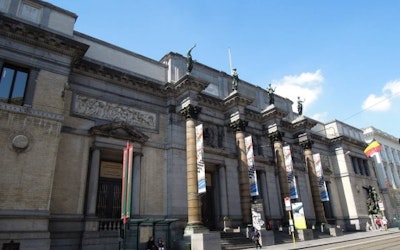
Musée Oldmasters Museum
Memling, Hieronymus Bosch, Quentin Metsys, Breughel, Van Dyck, Rubens, and an impressive number of other giants of painting make a date with you in a magnificent setting. This temple to art celebrates paintings from the 15th to the 18th century, presenting hundreds of masterpieces that command admiration. A garden of sculptures with a fountain completes the display.
 Musée Oldmasters Museum
The Mont des Arts Garden
The Mont des Arts garden is located below place Royale and provides a green transition between the upper and lower parts of the city, between the Royal Quarter and the Grand-Place in the city's historical centre.
Originally built for the 1910 Universal Exhibition, it was adapted in the 1950s to form part of the vast urban complex of the Mont des Arts. The Mont des Arts "complex" includes the KBR (formerly the Royal Library); a shopping and office gallery on the other side of the street appropriately named the "Mont des Arts"; the Square congress centre, with its glass cube and statue of Albert I; gardens and esplanades and finally an underground car park...
The current garden was restored in 2001.
Don't miss the sound of the carillon, located in the lower part of the covered passageway, which brings joy to tourists and Brussels residents alike!
Facilities:
- Benches
- Fountains
- A skatepark
Disabled access:
Only via the entrance on rue du Mont des Arts; other access is via flights of stairs.
 The Mont des Arts Garden
Royal Museums of Fine Arts of Belgium
The Royal Museums of Fine Arts of Belgium assemble six different museums: the Oldmasters Museum, Meunier Museum, Wiertz Museum and the Magritte Museum.
 Royal Museums of Fine Arts of Belgium
Brussels' Palace of Justice
Standing in front of this gigantic building leaves you (almost) dizzy. Everything is done to impress, both inside and out. It's a symbolic place with a long history, built on the (rather aptly named) Mont des Potences, meaning Gallows Hill, where condemned men were executed in the Middle Ages. Legend has it that in the 16th century, the famous doctor Vesalius went there at night to steal corpses so that he could study the human body…
It’s one of the most impressive monuments in Brussels, which also offers a breathtaking panoramic view of lower Brussels.
A little history
In March 1860 (under Leopold I), the Belgian government organised an international competition for the construction of a new courthouse in Brussels. The jury did not select any of the projects presented and the project was instead entrusted to the architect of the City of Brussels (who was on the jury!). Joseph Poelaert's project was colossal: to synthesise the history of humanity in the architecture of a single building. The construction, which finally began in October 1866, took 17 years. It led to the sacrificing of part of the Marolles, the working-class district in the lower part of the city, through expropriations at derisory prices, evictions and demolitions. The inauguration (under Leopold II) was held on 15 October 1883, without the architect of this colossus having seen his work completed. Exhausted and driven mad, he died four years before the work was completed.
The “Skieven architek” and “The Great Inkwell”…
The monument left no one indifferent. It was adored by some and mocked by others. Poelaert was granted tremendous artistic and financial freedom throughout the project, which led to popular, political and cultural discontent. A number of charming expressions were coined, such as 'Rotten' and 'Skieven architek' (twisted architect), with the latter being adopted as the name of a café on Place du Jeu de Balle in the heart of the Marolles. Victor Horta described the building as "... a crushing mass crowned by a cheese bell". Freud praised it highly: "At the top of a steep hill stands a massive building, with columns so beautiful that the whole evokes an Assyrian royal palace or an illustration by Gustave Doré". Victor Hugo christened it "The Great Inkwell".
Built in the classical Greco-Roman style and larger than Saint Peter's Basilica in Rome, it is (still to this day) the largest palace of justice in the world:
40,000m²
a dome that reaches a height of 100 metres
a colossal vestibule
over 250 rooms, including 27 impressive courtrooms…
"A cyclopean architecture, dreamed up by hands unaware of the human scale" (Victor Horta)
 Brussels' Palace of Justice
Egmont Park
Egmont Park is an English-style public garden which, in the 16th century, together with the Egmont Palace, was the property of Princess Françoise de Luxembourg, the widow of Count Jean d'Egmont. The palace was first home to the Ministry of Foreign Affairs before becoming a place for diplomatic receptions and conferences. This prestigious neo-classical building is richly furnished and decorated with tapestries, marble and a hall of mirrors…
To get to Egmont Park, take Passage Marguerite Yourcenar, where you'll be guided by quotes from one of the writer's novels, L'œuvre au Noir. Enter the Labyrinth and take the stairs leading to a rotunda, and you'll end up in the park. Admire the bronze statues and century-old trees. Round things off with a break at La Fabrique en Ville, where you can enjoy a beer brewed in Tour & Taxis and homemade desserts.
 Egmont Park
La Fleur en Papier Doré
The Gilt Paper Flower, a listed building since 1997, has for decades been a meeting place for locals and tourists alike, whether curious about or fascinated by the history of this 17th-century building. An estaminet for a long time under the premonitory name of Café des artistes, the Flower soon became what it is famous for today: the place where artists, particularly the Surrealists (Marcel Mariën, René Magritte, Louis Scutenaire, etc.) and the Cobras (Dotremont, Alechinski, etc.), met in an infernal flea market setting.
Open Monday to Sunday from 8am to midnight, La Fleur en Papier Doré offers a range of local produce (including Verschueren saison, beers from the De Ranke brewery, and Stouterik on draught from Brasseries de la Senne), which can be enjoyed with a portion of cheese or sausage. Since its reopening in May 2023, The Gilt Paper Flower has closed its kitchen to concentrate on its role as a café.
The venue also has two rooms where the public can enjoy a programme of lectures, concerts, poetry and literature...
 La Fleur en Papier Doré


.jpg/_jcr_content/renditions/cq5dam.thumbnail.48.48.png "1176081710")





WBT-JPRemy-%C2%A9%20WBT%20-%20J.P.%20Remy.jpg/jcr:content/renditions/cq5dam.zoom.2048.2048.jpeg "Petit Sablon & l'église Notre-Dame des Victoires - Kleine Zavelsquare & O.L.V. Ten Zavel")