DROHME Park
 DROHME Park
Van Buuren Museum and Gardens
Nestled in the heart of a listed Art Deco architectural and furnishing estate, the van Buuren Museum & Gardens unveils a cultural treasure of rare beauty. Erected in Uccle in 1928 by architects Léon Govaerts and Alexis Van Vaerenbergh, the villa embodies the very essence of Art Deco, preserving its international character influenced by Dutch and French schools.
Inside, an invaluable collection of rare furniture, signed carpets, stained glass windows, sculptures, and masterpieces offers a fascinating dive into art history. This residence, a true architectural gem, has remained intact over the years, thus preserving the integrity of the Art Deco ensemble.
The art collection of the van Buuren Museum & Gardens, reflecting the taste of the owners, offers a captivating overview of art from the 15th to the 20th century. It presents Belgian and international masterpieces, allowing visitors to discover the unique aesthetics of the van Buurens.
The van Buuren Gardens, designed by two of the most prominent Belgian landscape architects, Jules Buyssens and René Pechère, span 1.2 hectares, harmoniously combining picturesque elements and Art Deco. As witnesses of the evolution of the Nouveau Jardin Pittoresque, these gardens offer a unique, immersive experience through six distinct spaces. The recognition of the gardens by the European Route of Historic Gardens attests to their exceptional cultural, historical, and artistic value.
Since its establishment in 1970 by Alice van Buuren, the van Buuren Museum & Gardens Foundation has been committed to preserving and disseminating this cultural treasure. Open to the public since 1975, the museum offers a varied artistic program, enriching the cultural landscape of the region.
 Van Buuren Museum and Gardens
Tour & Taxis park
With its nine hectares, Tour & Taxis Park is the largest park in the center of Brussels. Until 2014, it was an abandoned railway site. Now, urban farming is even practiced there, and sustainable food is promoted thanks to Parckfarm. This initiative involves many people in this green space.
There is a community orchard, a vegetable garden, a neighborhood compost, a chicken coop, beehives, and a bread oven. The bees promote the park’s biodiversity. Be sure to get a jar of honey. At the Farmhouse, a greenhouse with a cafeteria, you can enjoy vegetarian dishes made from local products. There’s a reading corner and you can play various games there.
Join one of the guided tours, activities, or workshops. You can even garden or bake bread. There is also an obelisk in the park. If you look closely, you will see that all the articles from the Universal Declaration of Human Rights are inscribed on it. The playground in the park was built with materials recovered from the former railway line that used to run there.
What you absolutely must not miss is the Gare Maritime, a beautiful hall with a food market. If you love beer, be sure to visit one of the many breweries in the neighborhood.
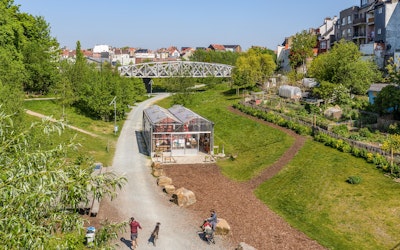 Tour & Taxis park
The Sonian Forest
Covering some 4,000 hectares, the Sonian Forest is the green lung of Brussels, despite being crossed by roads, motorways and railway lines. This peri-urban green space is home to nature, forest and archaeological reserves. The Bois de la Cambre is a gateway to this forest, which stretches over the Brussels-Capital Region, Flanders and Wallonia.
Make your way to the edge of the Sonian Forest to discover Rouge-Cloître, a former abbey that's now a wonderful place for walks and activities, which also hosts artists. Take a walk in the Tournay-Solvay, Ten Reuken, Seny and Bergoje parks and the Jean Massart Botanical Garden, one of the richest in the country.
 The Sonian Forest
Jean Massart Botanical Garden (ULB)
Named after its founder, the Jean Massart Botanical Garden was created in 1922 by this great defender of nature and professor of botany at the ULB (Free University of Brussels). It's located in Auderghem, a stone's throw from Rouge-Cloître, the Sonian Forest and the Seny, Ten Reuken and Bergoje parks.
This botanical garden was designed by landscape architect Jules Buyssens. With some 2,000 plant species, it's one of the richest botanical gardens in Belgium and a real living museum. Admire the thousands of native and exotic plants that the gardeners, researchers and students take care of every day. The garden is an open-air laboratory for studying how plants can make cities healthier and more sustainable. It's also a museum of ULB and is part of the science trail, together with the Museum of Zoology.
 Jean Massart Botanical Garden (ULB)
Laeken Park
As its name suggests, Laeken Park is located in the northern Brussels district of Laeken. It's part of the Royal Estate, together with the Osseghem and Sobieski parks, and the Colonial Garden and the Florist's Gardens. They form a large, landscaped estate within walking distance of the Atomium.
This French-style park has paths, winding walkways, lawns and copses. An avenue of magnolias leads you to the flamboyant neo-Gothic Dynasty monument. It houses a statue of King Leopold I, a spire similar to that of the City of Brussels Town Hall and nine arches topped by nine pinnacles, referring to the number of provinces in the country at the time. Discover also the chapel and the fountain of Saint Anne and the former United States pavilion of the 1958 Universal Exhibition.
Take a stroll through the green areas surrounding Laeken Park and visit the Atomium, Mini-Europe, the Planetarium and the Design Museum Brussels. The Japanese Tower and the Museums of the Far East are just a stone's throw away.
 Laeken Park
Le Logis and Floréal Garden Cities
The garden cities of Le Logis and Floréal are without a doubt the crowning jewels of Belgium’s garden cities. The two cities, whose construction began in 1922, were designed as one large estate but on behalf of two separate cooperatives. Le Logis housed the employees of the Caisse Générale d’Epargne et de Retraite (GGER - General Pensions and Savings Fund) and civil servants. Floréal was built a year later at the initiative of typesetter workers. Listed since 1999, this village in the city comprises 1,500 properties with a host of public facilities and shops, over 80 hectares!
The houses are characterised by a rough, grey rendering. The whole garden city is admired for its flourishing vegetation, including its hundreds of Japanese cherry trees, orchards, wisteria, jasmines, etc. Spring is the perfect season to stroll around it, and why not have a picnic?
 Le Logis and Floréal Garden Cities
Georges Henri Park
Named after the avenue that runs alongside it, Georges Henri Park was once the Jewish cemetery of Etterbeek, from the end of the 19th to the end of the 20th century. You can still see some traces of this history: two obelisks, a Jewish memorial and a sculpture of a woman and her child, in homage to the women and children who disappeared in the German camps during the Second World War. Next to the sculpture, engraved on a lectern, you'll find a poem by Marguerite Bergers, who was beheaded in Wolfenbuttel in 1944. You can also admire Lucia Bru's sculpture of a boat made of wood, steel and metal. This piece won the Brussels-Capital Region's inaugural sculpture competition.
As you enter the park, you come across a large round fountain with a powerful jet of water flowing from it. Take a walk through the scented garden, stroll through the classical gardens or visit the garden of remembrance and its Jewish memorial.
 Georges Henri Park
Forest Park
Forest Park, which also stretches over into neighbouring Saint Gilles, is spread over 13 hectares and criss-crossed by 18,000m² of paths and pavements. Admire its magnificent flower beds, groves and trees.
There are several shops around the park to satisfy your taste buds. My Tannour offers you a taste of Syrian-Lebanese cuisine while Fernand Obb Delicatessen lets you enjoy some of the best shrimp croquettes in the capital. For those with a sweet tooth, COCO Donuts invites you to rediscover the much-loved beignet and coffee-roaster and chocolatier, Jérôme Grimonpon, serves his marvellous chocolates and other divine chocolatey pastries. You even get the opportunity to observe him making his delicious sweet treats in his open workshop!
Last but not least, attend a concert or a show at Forest National, the famous concert hall located just around the corner from Forest Park.
 Forest Park
Wolvendael Park
Wolvendael Park in Uccle is one of the most beautiful in the Brussels region. Formerly known as 'woluesdal', which means 'turning valley', it is laid out in the style of English gardens and offers plunging views thanks to its steep incline. Pass through its beech groves to admire its magnificent trees, some of which are even blue or red: chestnuts, beeches, walnuts, cypresses, weeping silver limes…
Discover the classical castle and the Louis XV pavilion, which houses a restaurant. Dating back to the 18th century, it used to be in Amsterdam before being deconstructed and rebuilt in the park at the beginning of the 20th century. Built in the refined style of Versailles, it was fitted with a dome and decorated with numerous features: sculpted frieze, mascaron, medallion, stucco, etc…
Visit the green theatre and admire the bas-relief dedicated to Belgian writer Charles de Coster.
Take advantage of your visit to Uccle to go for a stroll through the nearby Dieweg cemetery.
 Wolvendael Park
Tournay-Solvay Park
Named after Thérèse Tournay-Solvay, daughter of Alfred Solvay and widow of Émile Tournay, this park, located in Watermael-Boitsfort, is one of the most beautiful in Brussels. There are a variety of spaces and slopes, two ponds in its valley, a natural forest on its slopes and an English garden at the top.
As for heritage, discover the ruins of Solvay castle, which was destroyed in a fire in 1982 and has now been overrun by vegetation. Built in the Flemish neo-Renaissance style, it was the property of Alfred Solvay, brother of the famous industrialist Ernest Solvay, and his family. The castle's stables are now occupied by a centre for environmental and ecological education. Admire the rose garden designed by Jules Buyssens and the sculptures, including the replica of the Olmec Head no 8, a work by Ignacio Pérez Solorzano which was discovered in the Mexican village of San Lorenzo.
 Tournay-Solvay Park
Elisabeth Park
Situated along a wide avenue that straddles Koekelberg and Ganshoren, Elisabeth Park opens up one of the longest and most beautiful vistas in the Brussels-Capital Region. It stretches from the National Basilica of the Sacred Heart in Koekelberg to the Botanique. Take a walk through the park along the winding paths and alleys that form the 'L' of Leopold, in reference to King Leopold II.
Visit the Basilica, a building commissioned by King Leopold II, which was started in the early 20th century and completed some 50 years later! Inspired by the neo-Byzantine style, this Art Deco masterpiece of reinforced concrete and brick is one of the largest churches in the world!
Just a stone's throw away, the Belgian Chocolate Village - with its chocolate workshops - lets you discover the history and secrets of the chocolate-making process. You can also visit chocolate roaster Frederic Blondeel: watch him at work in his open workshop and treat yourself in his bar and shop.
 Elisabeth Park
Cinquantenaire Park
Built in 1880 to mark the 50th anniversary of Belgium's independence, Cinquantenaire Park is both a collection of French-style gardens and a historical site that's home to monuments, sculptures and museums. It's dominated by a triumphal arch with three arches and a bronze quadriga at its summit, which offers a stunning panoramic view of the capital. The wide paths lead to the Pavilion of Human Passions designed by Victor Horta, the Royal Museum of the Armed Forces and Military History, the Art & History Museum and Autoworld, the car museum.
Take part in events here throughout the year: sporting events, festivals, concerts, fireworks... In the summer, you can enjoy a short break at the Guinguette Maurice pop-up bar.
 Cinquantenaire Park
The Bois de la Cambre
The Bois de la Cambre, one of the largest parks in the Brussels-Capital Region, owes its name to La Cambre Abbey. It's laid out in an English style and resembles a forest, with walks, pony rides, jogging and playgrounds.
Nestled in the heart of the Bois de la Cambre, Chalet Robinson welcomes you in its restaurant and offers boats and pedalos or a game of pétanque. Located on Robinson Island, the origin of the name is unknown but, according to legend, a group of walkers who were lost in the Bois de la Cambre saw a captain appear on the water in his boat, and he took them to this green island. The Le Flore bar offers tapas made with fresh seasonal produce, while the Woodpecker is ideal for a snack. The nearby Villa Lorraine, Villa in the Sky and Villa Emily are fine, gourmet restaurants. Looking to go out in a club? Head to Les Jeux d'Hiver, one of the most famous in Brussels.
Just a short distance away is the Villa Empain, an Art Deco jewel which today houses the Centre for Art and Dialogue between Eastern and Western Cultures. DROHME Park leisure park at the former Boitsfort hippodrome lies on the southernmost edge of the Bois de la Cambre.
 The Bois de la Cambre
Meudon Park
Named after a Parisian neighbourhood, Meudon Park is in Neder-Over-Heembeek, a quiet and pleasant commune geographically close to, and yet far from, the hustle and bustle of the city centre. In the 18th century, this green space was a stately estate with an Italian-style castle, a terraced garden and a manor house. In the 19th century, it was redesigned in the French style, with the addition of an orangery, a greenhouse, ponds and waterfalls. Discover the remains of the castle, which once hosted Napoleon and Pope Leo XIII: its two Louis XV style entrance pavilions, the Romanesque towers and the thermal baths, among others.
Admire also the tower of the former church of Saints Peter and Paul, dating from the 12th century, and the Kluys, a former 15th century hospice.
Take advantage of your visit to the district to continue your journey along the Promenade Verte, which offers a wealth of rural landscapes as you travel around the capital: fields, woods, duckboards... Take a tour of the Ferme Nos Pilifs, where animals, a nursery and a grocery shop await you. If you're keen on adventure, then Sortilège offers you a medieval and fantastic adventure in nature.
 Meudon Park
Bergoje Park
Bergoje Park is a pleasant place to walk in Auderghem. With its steep, wooded slope, the Rouge-Cloître stream (Roodkloosterbeek) running below and its paths running down the hillside, this small park has retained all its character from the time when it was still connected to the Sonian Forest.
On the site of Bergoje (which comes from the Dutch "berg", meaning mountain, and "oje", meaning house), used to stand the Villa de la Bruyère, which has now been demolished and replaced by the Clos du Bergoje neighbourhood.
Close to the park lies Rouge-Cloître, a nature reserve that has been home to artists since the 15th century, including famous Belgian painter Hugo Van der Goes. This former abbey was a renowned site until the end of the 19th century, and has since become a genuine artists’ paradise.
 Bergoje Park
Jean-Felix Hap Park
Jean-Félix Hap Park is probably the most beautiful park in Etterbeek, with its majestic trees, large lawns and winding paths. It bears the name of the last owner of this family estate, which was passed down from generation to generation.
Go for a walk around the Orangery, discover the ruins of the Flemish Renaissance castle and admire the neo-classical house of François-Louis Hap. The park also has an educational ecological area, which promotes biodiversity.
Not far from the park lies Cauchie House, a must-visit Art Nouveau gem. Just a stone's throw away, head to Leopold Park or Cinquantenaire Park, where you can go for a stroll or visit Autoworld, the Art & History Museum or the Royal Museum of the Armed Forces and Military History.
For a sweet treat, head to Le Pain Quotidien.
 Jean-Felix Hap Park
Osseghem Park
At the foot of the Atomium lies Osseghem Park. Created by landscape architect Jules Buyssens in the picturesque English style, it offers you beautiful views of the wooded surroundings and its vast lawns. Enjoy the peace and quiet of this green space and stroll along its wide paths and winding lanes. Take a walk around the pond and, from the Adolphe Max memorial, follow its avenue of purple beech trees.
Pass through the green theatre, a hemicycle with gravelled terraces and low stone walls decorated with golden privet hedges. With its excellent acoustics, it hosts festivals and can accommodate up to 3000 people.
Visit the neighbouring green spaces: Laeken Park and the Jean Sobieski, Colonial and Florist’s Gardens.
You can also visit the Atomium, Mini-Europe, the Planetarium and the Design Museum Brussels. Not far from the park, admire the Japanese tower and the Museums of the Far East.
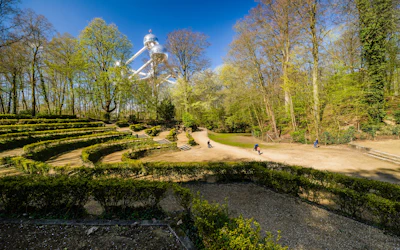 Osseghem Park
Vaux Hall, Parc de Bruxelles
The original Vauxhall, built in 1782 and opened in 1784 in the freshly landscaped park, was a sumptuous venue comprising a rotunda-style theatre, a cafe-cum-restaurant-cum-dance hall, and several pavilions for luxury retail. The City of Brussels took over the site in 1912 and decided to build a U-shaped covered gallery and a bandstand for musical ensembles. The site, which fell into disuse in the 1930s, underwent a major restoration by the City of Brussels in 2017, returning it to its original function as a venue dedicated to culture, art and music. The summer programme, known as Vaux-Hall Summer, is particularly popular and diverse.
 Vaux Hall, Parc de Bruxelles
Brussels Park
Brussels Park, known for many years previously as the Royal Park, is the oldest park in the region which became a public park. Built on the ruins of the park of the Dukes of Burgundy and the Governors of the Spanish Netherlands, it stands proudly between the Federal Parliament and the Royal Palace, symbols of power and the monarchy. This spot, was once the site of fierce battles for the people of Brussels during the revolution in 1830.
Designed in a neo-classical style by architect Guimard and gardener Zinner, it opens onto the large pond and then offers you wide alleys, symmetrical alignments and stunning views. You'll find statues of Greco-Roman mythology, the Vauxhall, a bandstand, the Théâtre Royal du Parc, the Guinguette Royale and even Kiosk Radio, a bar where you can dance beneath the trees!
 Brussels Park
Square du Petit Sablon
Designed in a Flemish neo-renaissance style, the flower garden of square du Petit Sablon is an architectural gem right opposite the Church of Our Lady of the Sablon. In Flemish neo-renaissance style, the flower garden of square du Petit Sablon is an architectural gem right opposite the Church of Our Lady of the Sablon. In this open-air museum, the various Brussels guilds of the day are personified by 48 statues and ten others represent the great humanists of the 16th century: Mercator, Ortélius... The flora reveals yet more symbolism: nine clumps of carved boxwood representing the nine Belgian provinces of the era and a crown for the kingdom as a whole.
At the bottom of the garden stands a fountain-statue in honour of the Counts of Egmont and Hornes, resistance fighters who were beheaded in the 16th century during the tyrannical Spanish regime. Last but not least, two flights of stairs lead you to Rue aux Laines and on to Egmont Park.
 Square du Petit Sablon
Josaphat Park
Josaphat Park is Schaerbeek's green lung and a favourite among the inhabitants of Brussels. According to legend, in the 16th century, a Brussels resident returning from the Holy Land was struck by the park's resemblance to the Valley of Jehoshaphat near Jerusalem, which gave the Park its biblical name.
Many activities are organised here: concerts, nature walks, discovery tours, etc. During your walk, admire busts of writers and artists and sculptures inspired by mythology or fairy tales. Discover the Love Fountain or the Trinkhall pavilion, a former castle and hotel-café-restaurant.
A stone’s throw from the park you’ll find Autrique House, the former private residence of Eugène Autrique, which was built in the Art Nouveau style by Victor Horta in the 19th century and is now a museum.
For a sweet break, head to Boentje Café, a zero-waste coffee house that prepares homemade dishes and desserts using local and seasonal products. Close by is Bar de la Mule, where you can enjoy typical German and organic beers made by Brasserie de la Mule.
 Josaphat Park
Seny Park
Seny Park, which was inaugurated in 1963, is located in both Auderghem and Watermael-Boitsfort and bears the name of one of its last owners. With a surface area of 3 ha, it is one of the green spaces that were developed in the valley of the little Woluwe river, which runs through the park. Take a walk through the park and discover its winding paths, its beautiful views, its geometrically shaped beds and its pond. Follow the trail of plants classified according to their scent, which is particularly enchanting for the visually impaired, and find an educational area dedicated to indigenous plant species.
Make the most of your walk in Seny Park to explore other nearby sites and green spaces: Ten Reuken Park, the Jean Massart botanical garden and the Rouge-Cloître. A little further away you'll find the rolling hills of Woluwe Park and Tournay-Solvay Park.
 Seny Park
Ten Reuken Park
Ten Reuken Park, which lies both in Auderghem and Watermael-Boitsfort and is crossed by the Woluwe stream, is close to the Sonian Forest. Go for a stroll around its pond or meander through its meadow, where the rare and delicate saxifrage blooms. As night falls, you may be lucky enough to spot one of the sixteen species of bats found in the park.
The park also houses sculptures, rockeries and rustic architectural elements that perfectly imitate plants or minerals. Sit in the gazebo overlooking the pond, walk across the wooden bridge to the waterfall or take the bridge with the tree branch railings. Admire the Padouk Arch installed on the pond, a sculpture by Jean-François Diord. It refers to the water mill that once fed the L'Espérance distillery, where the artificial waterfall is now located.
 Ten Reuken Park
Astrid Park
Created in 1911 as Anderlecht Park, Astrid Park has paid tribute to Queen Astrid by bearing her name since 1935, the year of her death. This green space was designed in 1926 by landscape architect Jules Buyssens.
The hilly terrain offers breathtaking views of the park's various areas. It's home to the Queen Fabiola Pavilion, the Aubette des Pêcheurs and Anderlecht football club (RSCA).
Visit Erasmus House and the Beguinage near Astrid Park. The former is one of Brussels' oldest Gothic houses, where the humanist Erasmus lived in the 16th century. Discover Gothic and Renaissance furniture and the intellectual world of that period. The Beguinage presents the history of Anderlecht and the former life of the beguines. Admire the collegiate church of Saints-Peter-and-Guy from its garden.
For a gourmet break, head to Friture René and the C'est si bon bakery.
 Astrid Park


